
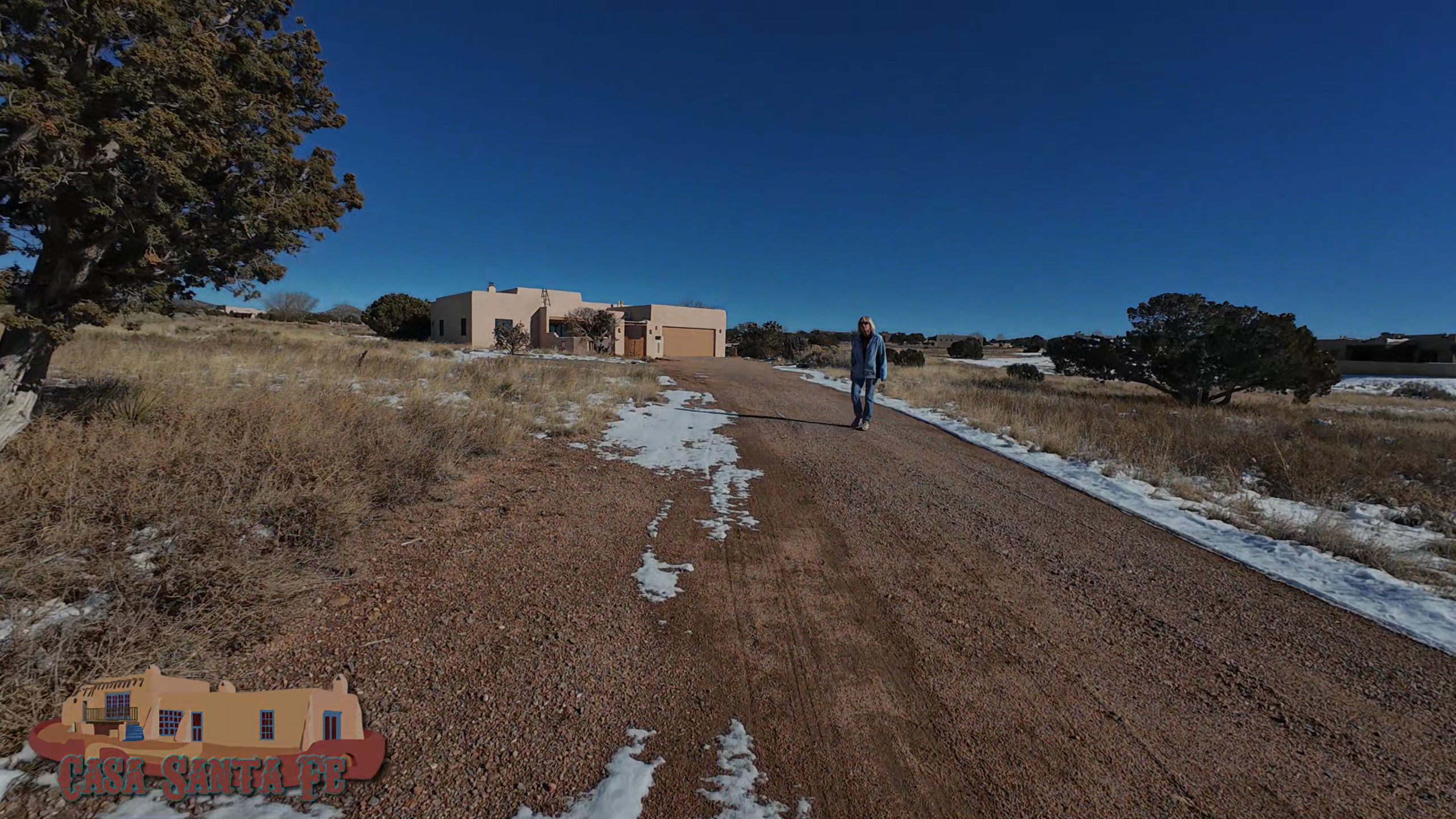
The fire crackled in the kiva fireplace, casting dancing shadows across the adobe walls of Casa Santa Fe as I sipped my morning coffee on that first day of January 2026. After almost a decade of escaping New Mexico's winter chill for the sun-drenched shores of Lake Mohave, Arizona, Paulette and I had made a decision that surprised even us—we'd spend this winter back in Santa Fe, embracing the snow and cold we'd been avoiding all these years.
The house greeted us with a crisp 60 degrees when we arrived, the thermostat faithfully doing its job of keeping pipes from freezing during our absence but hardly offering a warm welcome. I'd forgotten how patient you need to be with radiant floor heating. Unlike the forced-air furnaces I'd grown up with on those Kansas Flint Hills ranches, radiant heat takes its sweet time spreading warmth through a home. But there's something deeply satisfying about that gradual, even warmth rising from below—once it finally gets there.
While we waited for the floors to work their magic, I busied myself unloading the Subaru and then turned to a task I hadn't performed in years: building a proper fire in our kiva fireplace. There's an art to it, something ingrained in you if you've spent enough winters in high-country New Mexico. The piñon wood caught quickly, filling the house with that distinctive, sweet smoke that defines winter in the Southwest. Sitting there watching the flames, I realized how much I'd missed this simple pleasure—the primal comfort of a real fire on a cold winter's day.
Settling Back Into Mountain Life
That first week back in Santa Fe was an adjustment, relearning a rhythm we'd stepped away from years ago. Morning coffee tasted different somehow, richer perhaps, or maybe it was just the altitude sharpening my senses again. At 7,000 feet, Santa Fe sits high enough that everything feels a bit more vivid, more immediate.
Then, right on schedule, the weather did what winter weather does in New Mexico—it snowed. Not one of those massive dumps that can bury a town for days, but a respectable six inches that transformed our high desert landscape into something magical. I found myself back at the dining table each morning, cradling my coffee mug and gazing out at the juniper and piñon trees bowed under their white burden. It stirred memories of our years at Casa Oso, our log home perched at 9,500 feet above Angel Fire, where three to four feet of snow was the norm and the Sangre de Cristo Mountains loomed like ancient sentinels across the Moreno Valley.
Those seventeen years at Casa Oso taught us to love winter in ways I never imagined possible growing up on the plains of Kansas. Sure, we had snow there, but nothing like the mountain snow that transforms the world into a pristine wonderland. Nothing like waking to Wheeler Peak gleaming impossibly white against a cobalt sky, or watching the sun set fire to the peaks while Eagle Nest Lake lay frozen and still far below.
The Call of the Trail
By January eleventh, the wind had finally laid down—and if you've spent any time in New Mexico, you know that's cause for celebration. The wind here has personality, often cranky and relentless, capable of turning a pleasant winter day into an ordeal. But on this particular Saturday, the air hung still and the snow had begun its inevitable melt under the intense high-altitude sun.
"We should get out for a walk," Paulette suggested over breakfast. "The Santa Fe Rail Trail should be perfect today."
She was right, of course. After a week of settling in and a couple days of snow, we needed to stretch our legs and remember why we'd chosen to spend this winter back in the mountains. At our age—I'm an octogenarian now, though some days I still feel like that young ranch hand who could work from dawn to dusk—exercise isn't optional. It's maintenance, pure and simple. And there's no better way to maintain yourself than walking through country that feeds your soul.
The afternoon temperature had climbed to a pleasant 45 degrees by the time we headed out. In the bright sunshine and still air, it felt downright balmy. I grabbed a sweatshirt—years of living at altitude have taught me to respect the weather's ability to change its mind—and we headed out.
The Santa Fe Rail Trail: A Path Through History
The Santa Fe Rail Trail holds a special place in the heart of our community, and for good reason. This isn't just another recreational trail—it's a living connection to the past, following the historic route of the old AT&SF Railway (Atchison, Topeka and Santa Fe Railway) that once linked Santa Fe to the main rail line in Lamy, New Mexico.
For those unfamiliar with the area, Lamy sits about 18 miles southeast of Santa Fe, a small community that grew up around the railroad in the 1880s. The main transcontinental line bypassed Santa Fe due to the challenging terrain—those steep grades and tight curves that make our landscape so spectacular also made it impractical for heavy rail traffic. So a spur line was built from Lamy up to Santa Fe, and for over a century, this route carried passengers and freight to the territorial capital, later the state capital.
The last freight train ran this line in 1992, and the last passenger service ended in 1996. But rather than let this historic corridor disappear into the landscape, forward-thinking folks transformed it into the Santa Fe Rail Trail, preserving not just a path for hiking and biking, but a tangible link to the era when the railroad opened the West to the world.
Today, the trail runs for about ten miles from the Santa Fe Railyard on the south side of town all the way to Lamy. It's a gentle grade—railroads couldn't handle steep hills—which makes it perfect for octogenarians like me and folks of all abilities looking for accessible outdoor recreation. The trail surface is well-maintained crushed gravel, wide enough for walkers, runners, cyclists, and even horseback riders to share comfortably.
A Three-and-a-Half Mile Journey
Our plan was simple: walk from Casa Santa Fe down to Silver Spur Road and back, a round trip of about three and a half miles. Gone are the days when I could hike twelve miles to the summit of Wheeler Peak and back, logging 2,600 feet of elevation gain without thinking twice. These days, I pick my adventures more carefully, focusing on quality over quantity, on really seeing and experiencing rather than conquering.
The trail was in perfect condition despite the recent snow. The sun had done its work, leaving only patches of white in the shade of larger junipers and along the north-facing slopes. The crushed gravel crunched pleasantly underfoot, that distinctive sound that tells you you're making progress, going somewhere.
Right near the beginning of our walk, we passed a small ranch property that's become one of my favorite landmarks. Two miniature burros live there, and they never fail to charm. These pint-sized equines are descended from the burros that once packed supplies throughout the Southwest, before roads reached everywhere and trucks replaced hooves. Today's miniature burros are bred for companionship and charm, and these two deliver both in spades. They watched us pass with those impossibly large, liquid eyes, ears forward with curiosity, looking like toys come to life against the big landscape.
As we walked on, the trail revealed the character of this high desert country. To the east, the Ortiz Mountains rose dark and mysterious, an ancient volcanic range rich with mining history. These aren't tall mountains by New Mexico standards—the highest peak tops out around 8,800 feet—but they command attention, hunched and weathered, studded with piñon and juniper. Gold and silver were pulled from these hills in the 19th century, and they're part of the geological story that makes New Mexico such fascinating country.
The Sangre de Cristos: Ever-Present Majesty
But it's to the northeast where your eyes are really drawn. The Sangre de Cristo Mountains dominate the horizon, that magnificent southern spur of the Rockies that runs from just north of Santa Fe all the way up into Colorado. "Blood of Christ" they're called, named for the way they glow red in the alpenglow of sunrise and sunset, and even in the middle of a winter day they command reverence.
I never tire of these mountains. During our years at Casa Oso, we lived within them, surrounded by their peaks and valleys. Now, from Santa Fe, we see them from a different perspective—distant but ever-present, a reminder of the larger landscape we're part of. Wheeler Peak, New Mexico's highest point at 13,167 feet, isn't visible from the Rail Trail, but knowing it's there, knowing I've stood on its summit in younger days, adds depth to the view.
The rail trail itself tells the story of how humans adapted to this landscape. The original railroad engineers had to carefully survey and grade this route, balancing the need for gentle grades that locomotives could handle with the shortest practical distance. Walking it, you appreciate their work—the subtle curves, the careful cuts and fills, all designed to ease passage through terrain that was never meant to be easy.
Life Along the Trail
Midway to Silver Spur Road, we passed larger horse ranches, sprawling properties where the well-kept fences and neat barns spoke of serious equestrian operations. Horses grazed in winter pastures, their thick coats making them impervious to weather that would send me searching for another layer. Some lifted their heads to watch us pass, and I felt that familiar connection—ranch boy to ranch animals, a bond formed sixty-some years ago on the Kansas Flint Hills and never broken.
The Flint Hills of my youth were different country from this high desert—taller grass, wetter, more rolling than mountainous—but the fundamentals were the same. Livestock, land, weather, and the eternal cycle of seasons. Work that never ends but gives meaning to days. I've lived many lives since those boyhood years—pilot, construction company owner, fishing guide, publisher, web designer—but some part of me will always be that ranch kid, at home in open country, comfortable with animals and weather and distance.
Of course, I had my camera equipment along. Old habits die hard, and my current passion for documenting the wilderness and wildlife of the American Southwest through photography and video means I'm rarely without gear. The light on this winter afternoon was pristine—that crystalline quality you only get in high, dry air after snow has scrubbed the atmosphere clean. I captured video of the trail stretching ahead, of the mountains framing the horizon, of details that caught my eye: ice crystals still clinging to shadowed grass, the texture of juniper bark, the way afternoon light painted the Ortiz Mountains in shades of purple and gray.
These images and videos aren't just for me. I share them through the New Mexico Outdoor Sports Guide blog and YouTube channel, knowing that there are many folks who can't experience these places firsthand—through age, health, or circumstance. If my work can give them a window into this stunning landscape, can let them experience vicariously what I'm blessed to see in person, then the hours spent editing and uploading are worthwhile.
Fellow Travelers and the Gift of Good Weather
We weren't alone on the trail that afternoon. The combination of sunshine, still air, and melting snow had drawn others out for their own winter walks. We passed several couples, all of us exchanging smiles and greetings with that camaraderie that develops among people sharing a beautiful day in beautiful country. Some were our age or close to it; others were younger, perhaps with young children at home giving them a rare afternoon off. A few cyclists rolled past, their tires humming on the gravel.
There's something democratic about trails like this. The Santa Fe Rail Trail doesn't care about your background, your bank account, your politics, or anything else that divides people. It's simply there, offering itself to anyone willing to show up and put one foot in front of the other. In our increasingly fragmented world, these shared spaces where we can encounter each other as simply fellow humans enjoying the outdoors seem more precious than ever.
The walk out to Silver Spur Road took us about a half hour at our comfortable pace. Silver Spur itself is just a rural road that crosses the trail, marking a natural turnaround point. We paused there, enjoying the view back toward Santa Fe in the distance, the city nestled against the foothills of the Sangre de Cristos.
Connections Past and Present
From where we stood, I could imagine the old passenger trains that once rolled this route, carrying people between Santa Fe and the main line at Lamy. The romance of rail travel in that era—the 1920s, '30s, '40s—seems almost impossible to recapture now in our age of airports and interstates. But the Sky Railway, which now offers scenic excursions from Santa Fe down to Lamy and back, keeps that tradition alive in a new way.
The Sky Railway operates seasonal tourist trains along this historic route, and while the Rail Trail follows the same general corridor, the actual active tracks parallel it in places. These excursions are popular with visitors and locals alike, offering a chance to experience the landscape at railroad speed, which is to say slowly enough to actually see it, with the romance of vintage passenger cars and the clickety-clack of steel wheels on steel rails.
Paulette and I have taken the Sky Railway excursion a couple of times, and it's a different kind of magic than walking the trail—more social, more theatrical, with the drama of locomotives and the nostalgia of a bygone era. But I prefer the intimacy of walking, the direct connection to the land under my feet, the ability to stop and stare and really see without the schedule of a train dictating the pace.
The Return Journey
The walk back was just as pleasant as the walk out, the low-angle winter sun now behind us, throwing long shadows across the trail. Our shadows walked ahead of us like companions, stretched and distorted but faithfully following our movements. The temperature was beginning to drop as the sun lowered toward the horizon, and I was glad for that sweatshirt.
An hour for the round trip—that's about right for us these days. Not too strenuous, but enough to get the blood moving, to remind muscles and joints that they're still capable of useful work. It's a humbling thing, aging, watching your capabilities gradually narrow. But it's also oddly freeing. I no longer feel the need to prove anything, to push myself to extremes. Instead, I can simply enjoy what I can do, be grateful for each day that allows me to walk three and a half miles through beautiful country with my wife of over forty years at my side.
Santa Fe: A Place to Call Home
As we drove back to Casa Santa Fe, I found myself reflecting on the journey that brought us here. From those Kansas Flint Hills ranches to Houston and flight school, from running Centaur Installations to publishing fishing magazines, from building websites to building our dream log home at Angel Fire—each chapter led to the next in ways I couldn't have predicted but that make sense in retrospect.
Santa Fe feels like the right place for this stage of life. It's a city with small-town values, where art and culture thrive but you're never more than a few minutes from wild country. The Santa Fe Rail Trail is just one of many outdoor recreation opportunities within easy reach—the Dale Ball Trails network, Hyde Park Road leading up into the Sangre de Cristos, Bandelier National Monument with its ancient pueblos, and countless other spots where the past and present, the natural and cultural, interweave.
And yet, we still split our time, still escape the heaviest snow for the Arizona sun and the smallmouth bass fishing of Lake Mohave. Casa Codorniz waits for us there, a different kind of sanctuary in a different landscape. That's one of the gifts of this stage of life—the ability to have multiple homes, to follow the seasons, to optimize for comfort and joy rather than career demands or school schedules.
Looking Forward
Back at Casa Santa Fe, with the kiva fireplace warming the house and dinner preparations underway, I downloaded the day's photos and video to my computer. The footage looked good—the light had been as perfect as I'd thought, the mountains properly majestic, the trail inviting. I'd edit it over the next few days and add it to the growing collection of content documenting this corner of the American Southwest.
Outside the window, the snow that remained in shaded spots glowed blue in the twilight. The temperature would drop well below freezing tonight, refirming what had melted during the day, creating the freeze-thaw cycle that slowly but inexorably transforms mountains into valleys, rocks into soil, the present into the past.
But tomorrow would bring another day, another opportunity to explore, another chance to walk the Santa Fe Rail Trail or venture onto different paths. At this age, I've learned not to take any of it for granted—not the sunshine, not the still air, not the ability to walk three and a half miles, not the companionship of a woman who's been by my side for over four decades of adventures.
The Santa Fe Rail Trail will be there tomorrow, and the day after, winding through this high desert landscape, connecting past to present, city to countryside, offering itself to anyone willing to lace up their shoes and take that first step. And as long as I'm able, I'll keep accepting that offer, keep walking those miles, keep documenting this stunning corner of the world that I'm privileged to call home.
Because in the end, that's what life at any age comes down to—showing up, paying attention, being grateful for the good days when they come, and sharing the beauty you're blessed to witness with others who might not have the chance to see it for themselves.
The fire in the kiva crackled and settled, and I raised my coffee mug in a silent toast to the day, to the trail, to the mountains and the desert and all the wild country that makes this life worth living.



0 Comments