
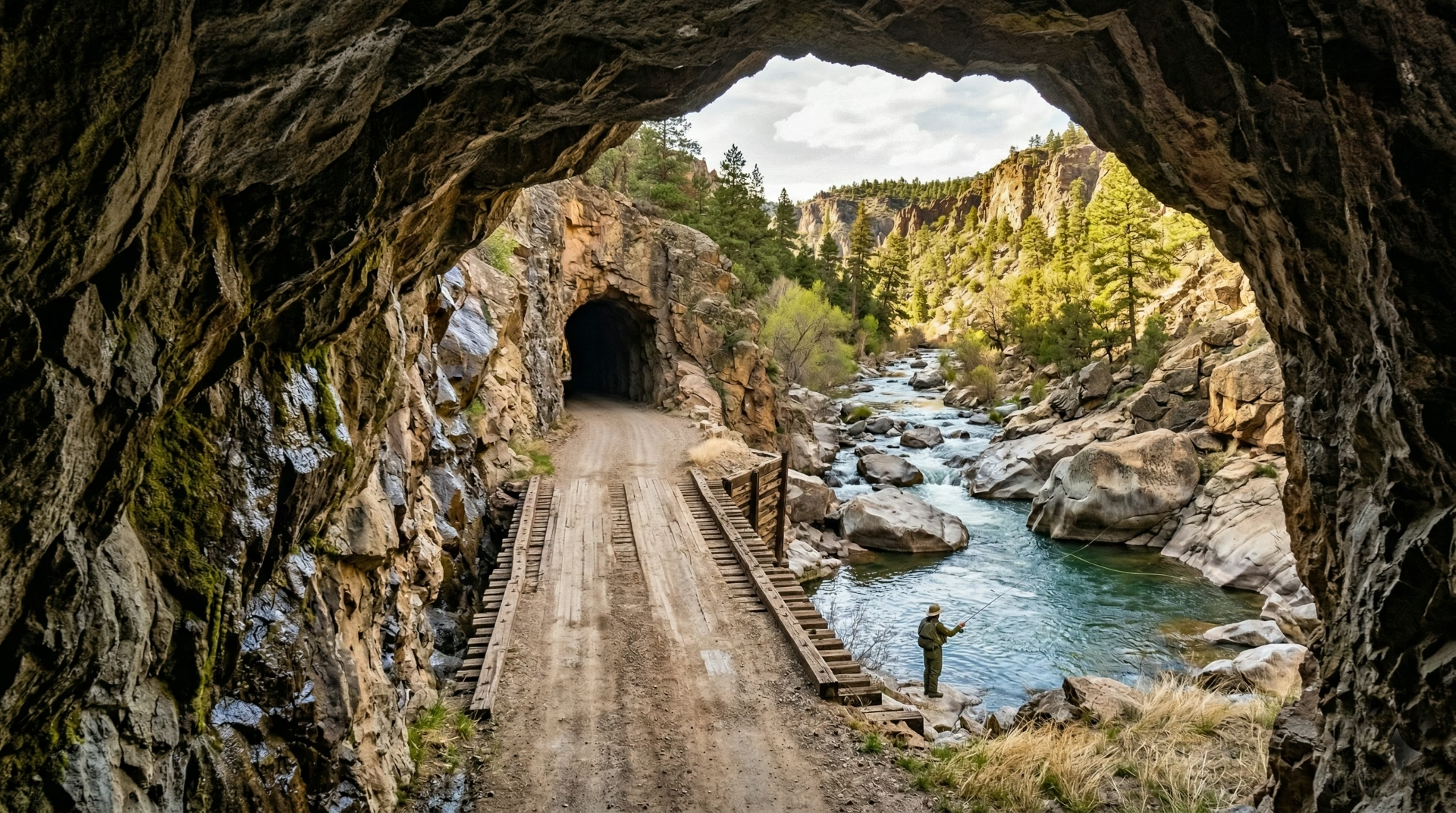
There are mornings in the high desert when everything just lines up right. The air carries that particular sweetness that only comes after a night of light rain, the light is soft and golden before it turns harsh, and you've got a full tank of gas, a charged camera battery, and nowhere specific to be until sundown. That was the kind of morning it was when Paulette and I pointed the truck north out of Santa Fe toward the Jemez Mountains and one of my favorite stretches of road — and river — in all of New Mexico.
The mission was straightforward enough: an easy four-mile hike up NM 376 along the Guadalupe River, shooting video along the way, scouting public access points for Guadalupe River trout fishing, and soaking in the kind of canyon scenery that makes you remember why you retired to New Mexico in the first place. But like most good days in the outdoors, it turned into something richer than the plan on paper.
Getting There: The Road Through Cañon
If you've never driven NM 4 west out of Bernalillo through the village of San Ysidro and up into the Jemez, you're missing one of the great scenic drives in the American Southwest — and I say that as someone who's covered a lot of ground between the Flint Hills of Kansas and the deserts of Arizona. The landscape shifts on you mile by mile, trading scrub and desert grassland for piñon-juniper country, then climbing into ponderosa pine and canyon country that feels like it belongs in another world entirely.
Before you reach the Jemez proper, you'll pass through the small village of Cañon, New Mexico, a quiet community tucked into the folds of the landscape that most visitors blow past without a second glance. Worth slowing down for, if only because the pace of life there reminds you what the Southwest was like before the Instagram crowds found it.
We made our first stop at the Walatowa Visitor Center, operated by the Pueblo of Jemez, located along NM 4 in Jemez Springs. If you're new to this part of New Mexico, this is the place to orient yourself. The center does a beautiful job of interpreting the culture and history of the Jemez people — the Towa-speaking pueblo whose ancestors have lived in this canyon for centuries. There are exhibits on traditional life, the land, and the deep relationship between the Jemez people and the rivers and forests that surround them. Admission is modest, the staff is genuinely welcoming, and the context it provides for everything you're about to see in the mountains makes the rest of the day feel more grounded and meaningful. Don't skip it.
Into the Jemez: The National Recreation Area
From Jemez Springs, NM 4 continues climbing into the Jemez National Recreation Area, a gem of the federal land system that doesn't always get the attention it deserves. Comprising 57,650 acres within the Santa Fe National Forest and administered by the U.S. Forest Service's Jemez Ranger District, the Jemez NRA is one of those places where the Forest Service has genuinely gotten the balance right. The recreation area is managed to promote trout fishing, camping, rock climbing, hiking, and hunting — yes, hunting is specifically permitted here — while protecting the watershed and the remarkable landscape of the Jemez Mountains.
To the north, the recreation area shares a border with Valles Caldera National Preserve, one of the most spectacular volcanic landscapes in North America. The caldera — a collapsed supervolcano nearly thirteen miles across — sits up there like a secret the mountains are keeping, and on clear days you can catch glimpses of its grassy bowl from certain high points along the ridgeline.
But today, we were river-bound.
The Gilman Tunnels: Where History Meets the Highway
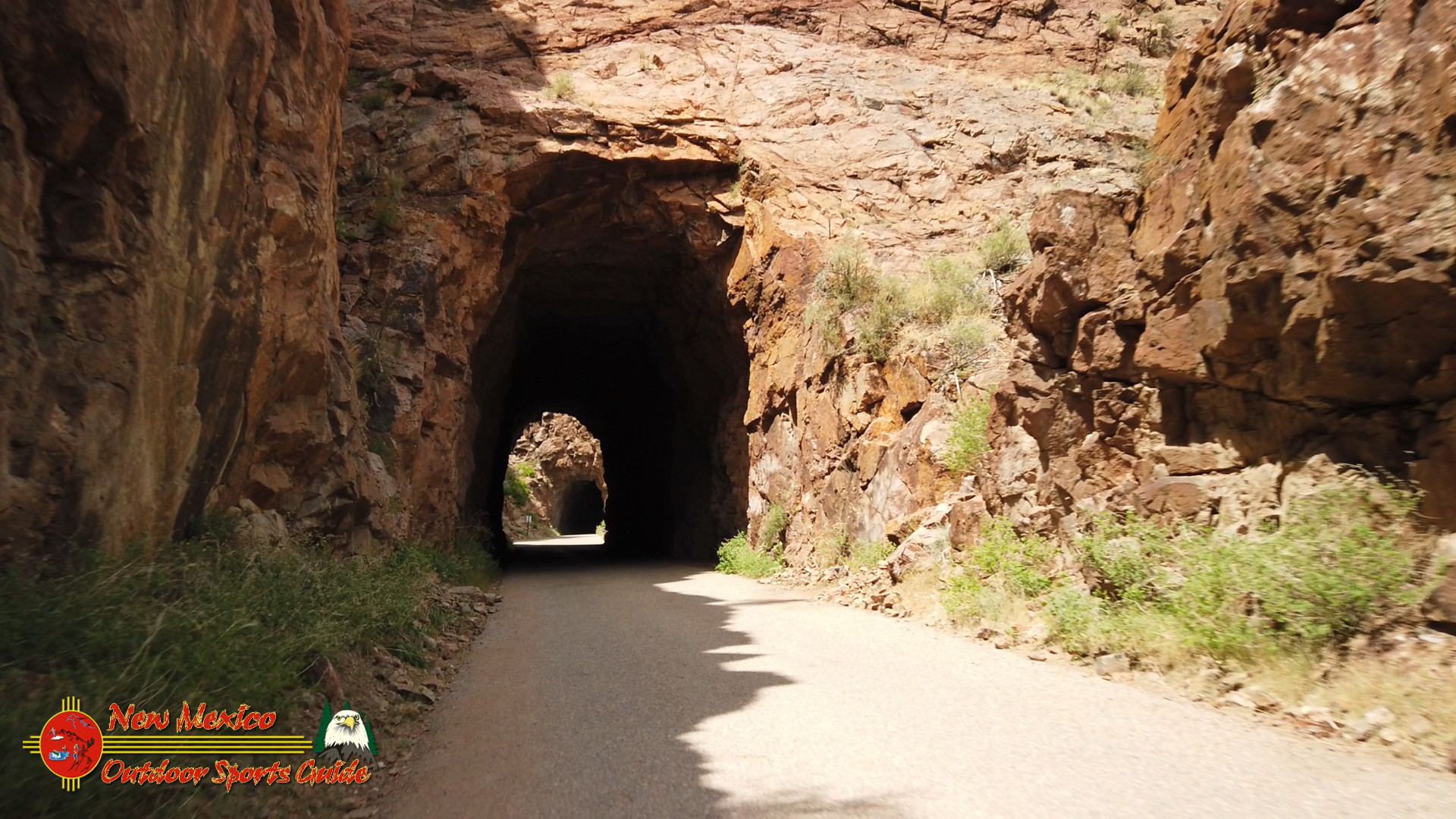
Before we ever pulled on a hiking boot, we turned off onto NM 376 to pay our respects to the Gilman Tunnels — and if you've never been, let me be direct with you: these tunnels belong on your New Mexico bucket list, full stop.
The tunnels are the surviving remnant of the Santa Fe Northwestern Railway, a narrow-gauge logging railroad that pushed its way into the Jemez Mountains in the early 1900s with one singular purpose: hauling timber. The forests up here were thick with ponderosa pine, and there was money to be made supplying lumber to a growing Southwest. The railway company did what railways did in that era — they blasted their way through whatever geography stood between them and the timber, which in this case meant punching two tunnels directly through the volcanic rock walls of the Guadalupe Box Canyon.
The tunnels themselves are remarkable pieces of early 20th-century engineering. Carved by hand and black powder through dark basaltic rock, they're rough-hewn and elemental, the kind of construction that makes you stop and think about the men who built them and what it cost in sweat and probably blood. The rock walls are streaked with mineral deposits, the tunnel ceilings are low enough to make you instinctively duck, and the whole thing has the feel of a place where history has soaked into the stone.
When the logging era ended and the Santa Fe Northwestern Railway was eventually retired, the tunnels weren't demolished or filled in — they were converted. Today, NM 376 runs right through them, making for one of the most unusual and photogenic stretches of state highway you'll ever drive. Two lanes of pavement passing through hand-carved mountain tunnels, with the Guadalupe River rushing alongside and sheer canyon walls rising on every side. I've driven it a dozen times and it still gets me.
And Hollywood has noticed. The Gilman Tunnels and the Guadalupe Box Canyon have served as filming locations for several major productions over the years. It's not hard to see why — the combination of dramatic geology, historical infrastructure, and that particular quality of New Mexico light creates a backdrop that's almost impossibly cinematic. The canyon feels timeless in the best possible way, equally at home in a period Western or a modern thriller.
Camera out, tripod set up, I burned through a good thirty minutes just shooting the tunnels before we even started hiking. Worth every minute.
The Hike: Four Miles of Good River Country
NM 376 beyond the tunnels transitions from highway to something more like a backcountry road, following the Guadalupe River upstream through the box canyon. It's not a wilderness trail — you're walking along the road, which is lightly traveled — but the canyon walls close in on both sides and the river is right there beside you, clear and cold and chattering over the rocks, and the overall effect is of total immersion in the landscape. It's the kind of walking where you cover four miles and it feels like two because there's always something worth stopping to look at.
The spring wildflowers were just beginning to show — patches of color against the grey and ochre canyon walls. The cottonwoods along the river were that electric green they get in April, before the heat of summer deepens and dulls the color. A red-tailed hawk worked the thermals above the canyon rim. Paulette spotted a great blue heron standing motionless in a shallow riffle, doing what herons do, which is look like they have infinite patience while the rest of the world rushes past.
For video purposes, the hike was a goldmine. The changing light through the canyon, the river reflections, the weathered rock faces, the occasional cascade where the Guadalupe drops over a ledge — every hundred yards offered another shot worth taking. If you're a photographer or videographer working the New Mexico outdoors beat, this canyon should be in regular rotation.
Guadalupe River Trout Fishing: Scouting the Public Water
Now, the other half of the mission: Guadalupe River trout fishing. And here is where things get genuinely interesting for anyone who chases cold-water species in New Mexico.
The Guadalupe isn't the most talked-about trout stream in the state — the San Juan up near Navajo Dam gets most of the glory, and the Rio Grande has its devotees — but the Guadalupe in the Jemez NRA is quality water, properly cold, well-oxygenated, and stocked regularly by New Mexico Game and Fish. The canyon stretches hold both rainbow and brown trout, and on a spring morning with hatches coming off the riffles, it fishes beautifully.
What I was specifically after on this hike was public access. The river along NM 376 runs through a mix of national forest land and privately held parcels, and if you don't know where you're legal to wade in, you can end up in somebody's front yard or, worse, in a confrontation over trespass. A river-right approach is particularly important in New Mexico, where the water law is complex and the attitudes about private land access are, shall we say, firmly held.
The good news: there are several solid public access points along the NM 376 corridor within the Jemez National Recreation Area boundary. I marked six locations on my GPS where anglers can legally access the river directly from the road right-of-way or designated Forest Service pullouts. The canyon water above the tunnels, in particular, holds good fish in the deeper pools where the current slows against the rock walls. I watched one pool for a good ten minutes and spotted the silhouettes of several decent-sized rainbows holding just off the bottom. Left them for another day — and a fly rod.
For anyone planning a dedicated Guadalupe River trout fishing trip, a few practical notes from the day's scouting:
Early morning is prime time. The canyon shades the river late into the morning, keeping water temperatures in the optimal range and the fish active longer than on more exposed streams. By midday in late spring and summer, the upper canyon heats up and the bite slows accordingly.
Dry flies work well on the riffles when caddis are hatching, which they were doing intermittently during our hike. Elk Hair Caddis in sizes 14-16 would have done real damage. In the pools, a weighted nymph rig — Hare's Ear or Pheasant Tail — fished deep is the reliable producer when surface action is off.
The river is wadeable in most sections during normal spring flows, though after significant snowmelt or rain events it can run high and off-color. Check the USGS gauge data before making the trip if you're planning to wade rather than bank fish.
And bring your fishing license. New Mexico Game and Fish takes enforcement seriously in the Jemez corridor, and the fines are not modest.
The Return: Why This Place Stays With You
We turned around at the four-mile mark, which put us back at the Outback a couple of hours before sunset — enough time to grab green chile cheeseburgers in Jemez Springs and watch the light go red on the canyon walls above the village. A good day's accounting, by any measure.
But here's the thing about the Guadalupe Box Canyon and the Gilman Tunnels that I keep coming back to. It's not just that it's beautiful — New Mexico has no shortage of beautiful places. It's that the place layers things on top of each other in a way that rewards attention. You've got the deep geological time of the Jemez volcanic field, then the indigenous history of the Jemez people who've lived in this watershed for a thousand years, then the industrial era of the Santa Fe Northwestern Railway cutting its way through the canyon in the early 1900s, and now the recreation era with anglers wading the riffles and hikers working the road and photographers burning through memory cards trying to capture light that keeps changing faster than you can chase it.
All of that is present simultaneously when you're walking up NM 376 on a warm spring morning with a camera in your hand and a river beside you. It's a lot to take in. That's a feature, not a bug.
Plan Your Trip
If you're putting together a Jemez weekend — and you absolutely should — the Gilman Tunnels and Guadalupe River hike pair naturally with the hot springs at Jemez Springs, the hiking at Battleship Rock, the Valles Caldera overlooks, and the ruins at Jemez Historic Site. The Walatowa Visitor Center in Jemez Pueblo is a worthy first stop to set the cultural context for everything that follows.
For Guadalupe River trout fishing, the Jemez National Recreation Area water within Santa Fe National Forest offers the best combination of access and fish quality. Early spring through early summer is the prime window before flows drop and temperatures rise. Fall can also be exceptional, particularly for brown trout in spawning mode.
The Gilman Tunnels are accessible year-round, though NM 376 can become tricky in winter conditions. Spring and fall are the sweet spots — good light, manageable temperatures, and the canyon at its photogenic best.
Go. Take the long way. Stop at the tunnels. Walk the river. It's worth every mile.

0 Comments