
Spring arrives in northern New Mexico quietly at first, like a slow exhale after a long winter. One day the air still carries a bite from the mountains, and the next the sun feels warm on your shoulders. The cottonwoods begin to glow with faint green halos, chamisa wakes from its gray winter nap, and the piñon and juniper seem to breathe a little deeper.
That was the kind of day Paulette and I found ourselves standing at the trailhead near Eldorado at Santa Fe, boots on gravel, ready to stretch our legs along one of our favorite stretches of the Santa Fe Rail Trail.
It had been a while since we’d walked this particular section, the roughly two-mile stretch between Eldorado and Seton Village. Close enough to Santa Fe for a quick outing, yet far enough from town that the desert opens up and reminds you just how big the sky is out here.
Some trails challenge you.
Others restore you.
This section of the Santa Fe Rail Trail does a little of both.
A Trail Built on History
Before it became a peaceful walking and cycling path, the Santa Fe Rail Trail carried the steel tracks of the old Santa Fe Railway. In the late 19th century, trains rolled through this corridor bringing goods, passengers, and possibility into northern New Mexico.
Railroads were once the lifelines of the American West. The tracks stitched together remote communities, mining towns, ranch lands, and frontier settlements.
Today, the rumble of locomotives has been replaced by something quieter.
Footsteps.
Bicycle tires crunching on gravel.
Wind brushing through juniper branches.
The Santa Fe Rail Trail stretches roughly 17 miles from Santa Fe south toward Lamy, following the historic railway route. Much of the trail still preserves the gentle grades that trains once required. For hikers, that means easy walking with just enough rise and fall to keep things interesting.
And for photographers and wanderers like Paulette and me, it means long views across one of the most beautiful landscapes in the Southwest.
Starting Out from Eldorado at Santa Fe
Eldorado sits about eight miles southeast of Santa Fe, tucked into rolling high-desert terrain at roughly 7,000 feet elevation.
It’s an interesting community, originally developed in the late 1960s with a vision of rural living and wide open space. Unlike dense urban neighborhoods, Eldorado spreads out across large lots where homes blend naturally into the landscape.
From the trailhead, you immediately feel that openness.
The land here rolls gently toward the foothills of the Sangre de Cristo Mountains, and the sky seems almost oversized. Clouds drift slowly across a pale blue canvas that stretches from horizon to horizon.
Paulette adjusted the brim of her hat as we stepped onto the trail.
“Perfect day for it,” she said.
And she was right.
Mid-March sunshine hovered comfortably in the mid-60s, warm enough for a light shirt but cool enough to keep the hike easy.
The Rhythm of the High Desert
Walking the Santa Fe Rail Trail has a rhythm to it.
The path rises and falls across shallow ridges left by ancient geological shifts. The grades are gentle, remnants of the railway engineering that once required smooth transitions for locomotives pulling long freight lines.
Every ridge reveals another sweeping view.
And the vegetation tells its own quiet story.
This is classic New Mexico high desert terrain.
-
Juniper trees, twisted and weathered
-
Piñon pines, small but resilient
-
Cholla cactus, glowing almost golden in the sunlight
-
Clumps of grasses greening up after winter
Cholla cactus are especially plentiful along this stretch of trail. Their segmented arms glow almost translucent when sunlight hits them just right.
They look beautiful from a distance.
Up close, they demand respect.
Anyone who’s hiked the desert long enough learns quickly that cholla have a remarkable ability to jump onto unsuspecting pant legs.
We kept a polite distance.
Vast Views in Every Direction
One of the reasons this section of the Santa Fe Rail Trail is so enjoyable is the scenery.
The trail sits on elevated ridges that open long views across northern New Mexico.
To the southwest, the rugged shapes of the Cerrillos Hills rise from the desert floor.
These hills hold a fascinating history of mining and trade that stretches back more than a thousand years. Turquoise was extracted here by Native American miners long before European explorers arrived.
Today, the Cerrillos Hills State Park preserves much of that history along with excellent hiking and wildlife habitat.
Farther west, faint but unmistakable, the distant silhouette of the Sandia Mountains stands against the sky.
On especially clear days, their granite faces glow pink at sunset, giving them the Spanish name Sandia, meaning watermelon.
Looking north from the trail, another dramatic skyline appears.
The southern San Juan Mountains rise faintly on the horizon, their snowy peaks sometimes visible far beyond the Española Valley.
And somewhere beyond those ridges sits Los Alamos, perched on mesas above the Rio Grande. The town carries deep scientific history tied to the Manhattan Project, but from this distance it’s simply another ridge along a vast mountain skyline.
The views remind you just how much geography surrounds Santa Fe.
Mountains, mesas, volcanic hills, and desert valleys all stitched together beneath that enormous New Mexico sky.
Discovering an Old Stone Trestle
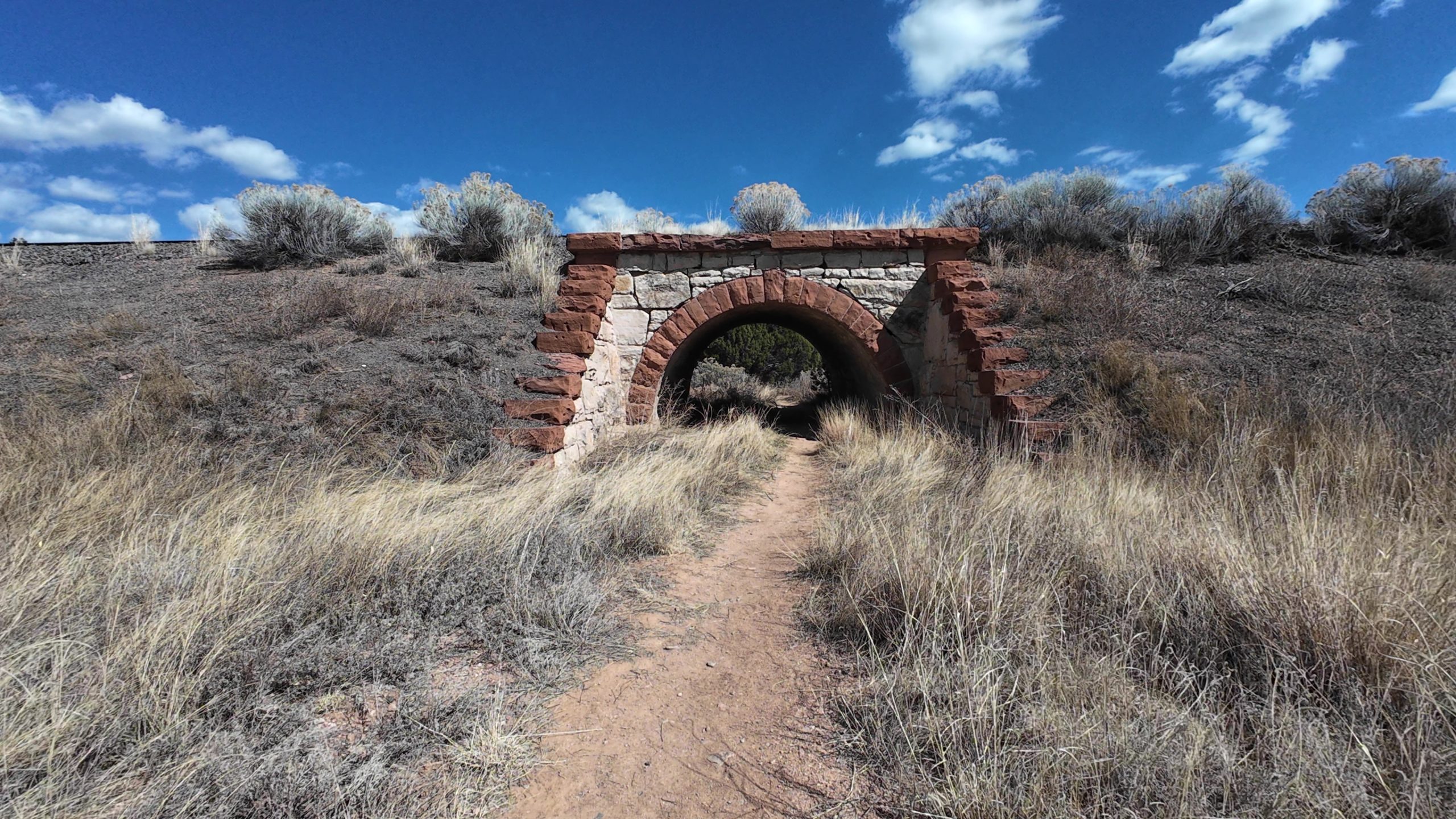
About halfway along this stretch of trail we came upon one of my favorite features.
An arched stone trestle.
These small railroad bridges appear occasionally along the Santa Fe Rail Trail, quiet reminders of the engineering that once carried trains across these hills.
This one curved gently over a shallow drainage.
The stonework was simple but sturdy, laid by hands that probably never imagined hikers and cyclists would one day pass overhead.
I paused to admire it.
Railroad structures have a certain honesty about them. Built to last, built to work, and built with the materials available at the time.
You can almost picture a steam locomotive rolling slowly across this spot more than a century ago.
The whistle echoing across the desert.
Freight cars clattering behind.
Now the only sounds were wind and our footsteps.
And the faint buzz of a camera recording the moment.
Filming the Journey for NMOSG
Of course, no outing these days feels complete without a little camera work.
I carried a small action camera, capturing segments of the walk for the New Mexico Outdoor Sports Guide (NMOSG) YouTube channel.
After years of wildlife photography and outdoor filming across the Southwest, documenting these moments has become second nature.
Sometimes it’s dramatic scenery.
Sometimes wildlife.
And sometimes it’s simply the feeling of moving through a place that still carries a quiet sense of the old West.
The Santa Fe Rail Trail fits that feeling perfectly.
It’s not wilderness exactly, but it still feels authentic.
A place where you can walk for miles and watch the landscape unfold exactly as it has for generations.
The Spirit of Seton Village
Eventually the trail begins drifting closer to Seton Village, a small historic community just south of Santa Fe.
Seton Village carries the name of Ernest Thompson Seton, a fascinating figure in American outdoor history.
Seton was a naturalist, artist, writer, and one of the founders of the Boy Scouts of America.
Long before outdoor education became fashionable, Seton believed deeply in teaching young people about nature, wildlife, and respect for the land.
In the early 1900s he established a community here called Seton Village, where he built a castle-like home and cultural center dedicated to nature study and outdoor learning.
His philosophy shaped much of what later became the scouting movement.
Walk through this area today and it’s easy to imagine Seton wandering these same hills with a notebook, studying wildlife tracks or sketching desert plants.
The landscape hasn’t changed much.
The same ridges.
The same piñon and juniper.
The same endless sky.
Turning Back Toward Eldorado
After reaching the Seton Village end of our planned route, Paulette and I paused for a moment before turning around.
A gentle breeze drifted through the junipers.
The afternoon sun hung comfortably in the western sky.
Not too hot.
Not too cold.
Just right.
Walking back along the Santa Fe Rail Trail, the landscape felt slightly different even though we were retracing our steps.
That’s one of the small pleasures of hiking.
The return trip always reveals something new.
Shadows shift.
Light changes.
A cactus you didn’t notice earlier suddenly stands out.
And the mountains seem to rearrange themselves depending on the angle of the sun.
Why the Santa Fe Rail Trail Is So Special
There are many hiking trails around northern New Mexico.
Some climb steep mountain ridges.
Others wander through forests.
But the Santa Fe Rail Trail holds a unique charm.
It blends history, scenery, and accessibility in a way few trails do.
A few things make it particularly special:
1. Easy Grades
Because it follows an old railroad route, the trail rarely becomes steep. That makes it ideal for casual hikers, cyclists, and long-distance walkers.
2. Expansive Views
Few trails offer such consistent panoramic views of surrounding mountains and high desert terrain.
3. Historical Character
Walking the old railway corridor connects hikers with an important piece of New Mexico history.
4. Close to Santa Fe
Despite its peaceful feel, the trail remains only minutes from the city.
Santa Fe: A City Different
Santa Fe proudly calls itself “The City Different.”
It’s a phrase you see everywhere, and after spending time in this region it begins to make sense.
Santa Fe sits at the crossroads of cultures.
Native American traditions.
Spanish colonial heritage.
Western frontier history.
A thriving modern arts community.
The Santa Fe Rail Trail reflects that layered identity.
It passes through historic settlements, modern communities like Eldorado, and landscapes that Native Americans walked long before railroads arrived.
Every mile holds stories.
Some recorded in books.
Others carried quietly by the land itself.
Wildlife Along the Trail
Even on a short hike, wildlife occasionally makes an appearance.
On this particular afternoon we spotted:
-
A red-tailed hawk circling high above the ridges
-
A pair of ravens gliding effortlessly in the wind
-
A few small desert cottontail rabbits darting into brush
In quieter hours you might also see:
-
Mule deer
-
Coyotes
-
Roadrunners
-
Various desert songbirds
The high desert supports a surprising amount of life once you slow down enough to notice it.
Springtime on the Santa Fe Rail Trail
Spring might be the best season to hike this part of the Santa Fe Rail Trail.
The weather tends to be ideal.
Cool mornings.
Warm afternoons.
And the desert slowly waking up after winter.
Soon the wildflowers will arrive.
Indian paintbrush.
Desert marigold.
Purple asters.
The hills will shift from muted winter browns to a soft patchwork of greens and color.
It’s a short season, but a beautiful one.
A Simple Two-Mile Escape
By the time we returned to the Eldorado trailhead, the afternoon sun had begun its slow slide toward the horizon.
Our little outing covered only about two miles each way.
Not a grand expedition.
Not a mountain climb.
Just a peaceful walk through a landscape that has a way of renewing the spirit.
And sometimes that’s exactly what you need.
A couple hours outside.
A little fresh air.
A reminder that the world is still full of quiet places waiting to be explored.
Final Thoughts: Why You Should Walk the Santa Fe Rail Trail
If you ever find yourself in northern New Mexico looking for an easy, scenic outing, the Santa Fe Rail Trail deserves a spot on your list.
Whether you walk a mile or the full length of the trail, it offers something rare:
A chance to move through history and landscape at the same time.
Old railroad grades beneath your boots.
Mountain ranges on the horizon.
Desert plants glowing in afternoon light.
For Paulette and me, it was simply a pleasant spring afternoon spent walking together through a place we’ve come to love after many years in New Mexico.
The camera captured the journey for the NMOSG YouTube channel, but the real reward was something simpler.
A sense of calm.
A little exercise.
And that familiar feeling of rejuvenation that always seems to arrive after a walk through the high desert.
Out here, along the quiet path of the Santa Fe Rail Trail, the land still whispers stories if you take the time to listen.

0 Comments