
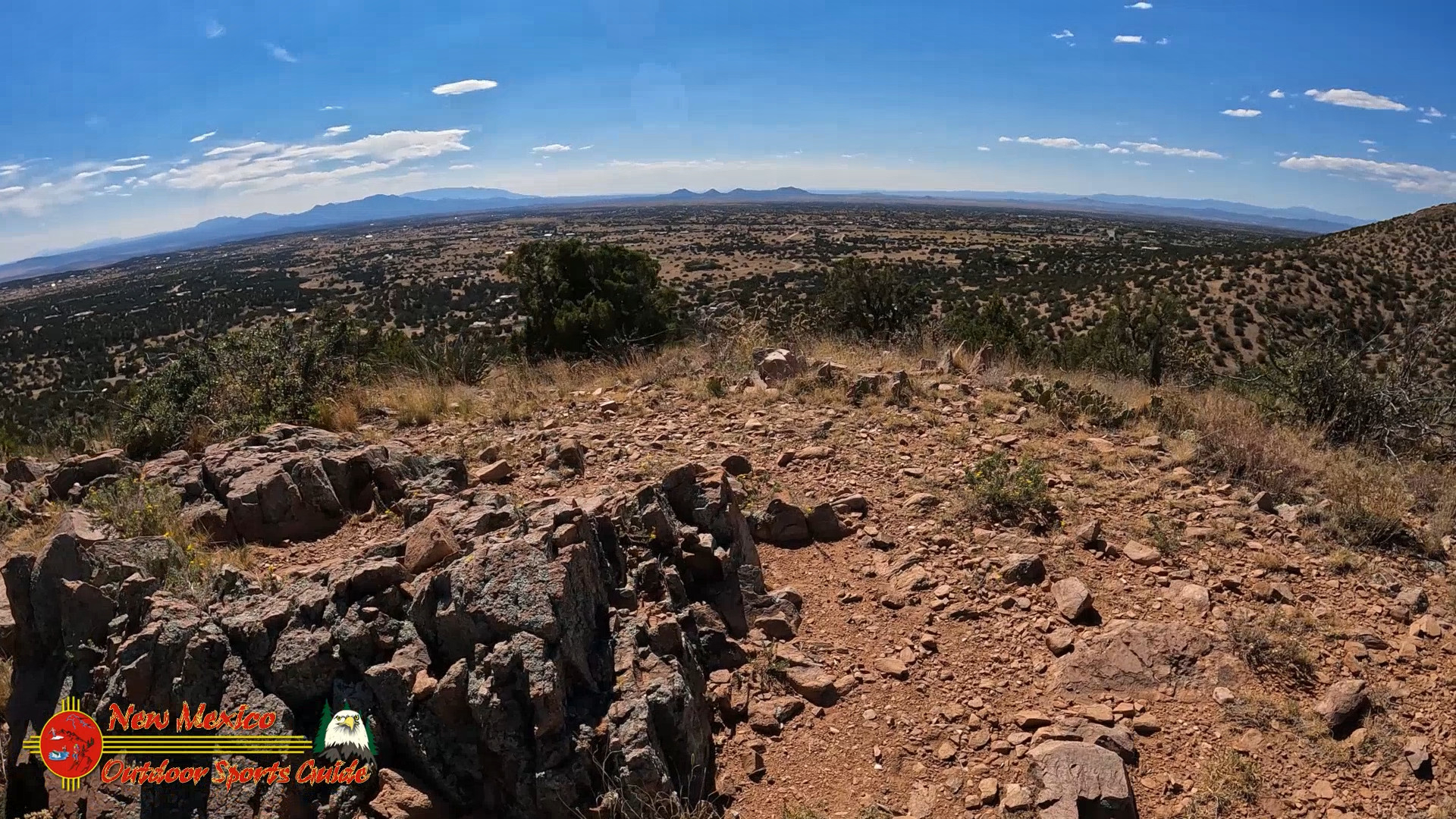
The Galisteo Basin is a surface basin and a closely related groundwater basin in north-central New Mexico. Its primary watercourse is the Galisteo River or Galisteo Creek, a perennial stream, for part of its course, that flows from the eastern highlands down into the Rio Grande about three miles above the Santo Domingo Pueblo. The Galisteo basin covers approximately 467,200 acres and runs from San Miguel County in the east, across Santa Fe County, and into Sandoval County at its westernmost point, the Rio Grande. Northeast of Galisteo Basin rise the Sangre de Cristo Mountains and to the southwest lie the Sandia Mountains. Because of its location lying between mountain ranges and connecting the upper Rio Grande Valley with the Great Plains, the Galisteo Basin was used as a trade route by prehistoric and historic indigenous and later also by the Spanish explorers.
The north fork of the Galisteo River arises in the southern Sangre de Cristo Mountains on the slopes of Thompson Peak and Glorieta Baldy. It includes flow from Grasshopper Canyon Creek, Deer Creek and Apache Canyon Creek. It is joined by the east fork just south of the town of Galisteo. The east fork of the Galisteo River, also known as the San Cristobal Arroyo, flows off of Rowe Mesa and Glorieta Mesa. A major tributary of the east fork is Padre Springs Creek. The south fork joins the river about 3.5 miles below the east fork. The south fork of the Galisteo River, also known as the Arroyo de la Jara, drains from the eastern and southern slopes of the basin. Its major contributor is Gaviso Arroyo.
After the three fork join, the river flows northwest for about 30 miles (48 km) into the Rio Grande. The tracks of the BNSF railroad run beside the Galisteo River for most of this distance, turning south about 2 miles before the river enters the Rio Grande. After the three fork join, the river receives flow from the north off the height of land south of the city of Santa Fe, including Gallina Arroyo, San Marcos Arroyo and Canada de la Cueva. From the south it receives flow off the eastside of the Ortiz Mountains from Arroyo la Joya, Arroyo Canamo, Cunningham Creek, and Arroyo Viejo.
The Galisteo Basin has a rich cultural history being a part of Pueblo culture (Eastern Anasazi). It is widely considered one of the most impressive archeological sites in the United States. Most of the sites are currently closed to the public. The most famous Pueblo ruin within the basin is San Cristobal Pueblo. From the 14th to the early 15th century, the pueblos in Galisteo Basin were trade centers. After 1680, the basin was abandoned. Various peoples, known and unknown, inhabited the area, including the Tano (Arizona Tewa), East Rio Grande Keresan, Pecos, and Tewa.
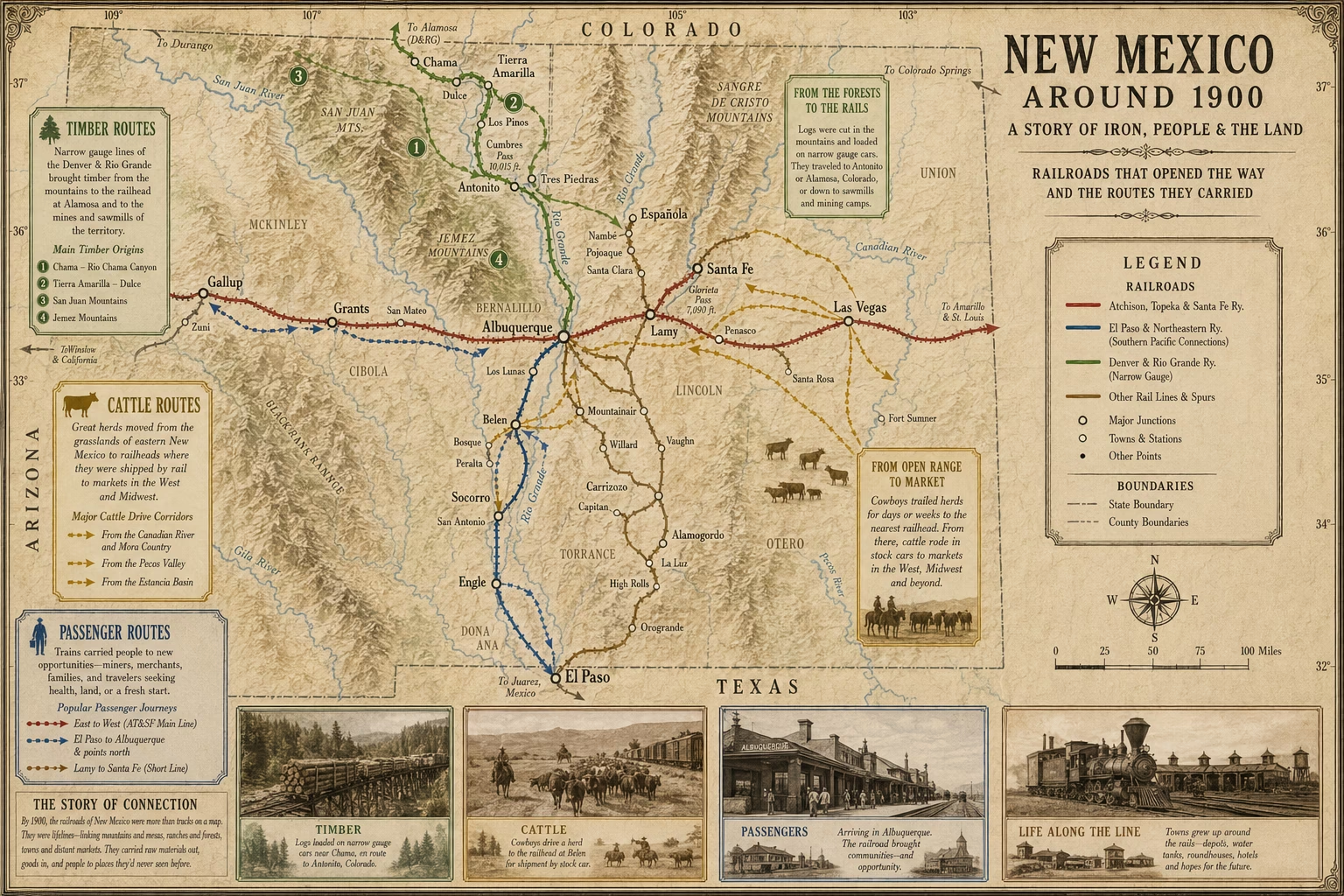
Lamy is part of the Santa Fe, New Mexico, Metropolitan Statistical Area. The population was 218 at the 2010 census. The former Atchison, Topeka, and Santa Fe Railroad (ATSF), now the Burlington Northern Santa Fe (BNSF), passes through Lamy. This railroad, usually called just the "Santa Fe," was originally planned to run from Atchison, Kansas, on the Missouri River, to Santa Fe, the capital city of New Mexico, and then points west. However, as the tracks progressed west into New Mexico, the civil engineers in charge realized that the hills surrounding Santa Fe made this impractical. Hence, they built the railway line though Lamy, instead. Later on, a spur line was built from Lamy to Santa Fe, bringing the railroad to Santa Fe at last. In 1896 the Fred Harvey Company built the luxurious El Ortiz Hotel here. Thus Lamy became an important railroad junction. From 1992 to 2014, the spur line was taken over by the Santa Fe Southern Railway, which operated a popular excursion train, using vintage passenger railcars and modern freight cars, between Santa Fe and Lamy.
Since March, 2022 the scenic train is called Sky Railway. What sets Sky Railway apart is twofold. First, it’s a year-round venture, and second, it isn’t the origin or the destination that’s important so much as the adventure unfolding while onboard. While gorgeous sunsets, spectacular night skies, and a convenient bar are big draws, it’s the themed experiences that are creating a stir.
Reviving the old Santa Fe Southern line was just the beginning. It took the combined talents of founders George R.R. Martin, Bill Banowsky, and Catherine Oppenheimer, along with Sky Railway Director of Entertainment Steven Wilson and Director of Operations Bryan Deutsch, to create a uniquely stimulating experience, different from any other short-line railroad in the country.
Lamy Train Station was commonly the first stop for staff and their families arriving to New Mexico on their way to the secret city of Los Alamos. The terrain around Santa Fe made building train tracks a challenge, so Lamy, New Mexico, just south of Santa Fe, was selected for the train depot. The current Lamy Train Station was built for the Atchison, Topeka, and Santa Fe Railway in 1909, replacing a two-story wood-frame structure erected in 1881.
The Lamy Train Station was a Spanish Mission-style train station in the middle of nowhere. With a red-tile roof and stucco walls, this train station was just the beginning for new staff arriving to New Mexico. However, from here a shuttle would arrive and transport workers to their next stop. At 109 E. Palace, Dorothy McKibbin gave all new arrivals their top –secret clearance pass and give them directions to their new home - Los Alamos.
0 Comments